Emergency Leave Advice (Post Natural Disaster)


Scenario 1 – You are dealing with an active emergency at home (Emergency Leave)

If your home or living situation has been directly impacted — structural damage, flooding, unsafe conditions, major debris, evacuation or displacement — you should be eligible for Emergency Leave.

This leave is designed to give you time to:

  • make your home safe

  • organise urgent repairs

  • arrange temporary accommodation

  • deal with insurers or essential services

  • stabilise immediate living arrangements.

A template email for requesting Emergency Leave is available here.


Scenario 2 – You volunteered as part of the official emergency response (Emergency Management / Miscellaneous Leave)

If you:

  • volunteered with an official emergency service (NTES, Bushfires, Fire & Rescue, etc.), or

  • volunteered or were directed by the Department to assist in a shelter or other emergency operation,

you should be entitled to Emergency Management / Miscellaneous Leave, or to have that time treated as duty.

This leave ensures you are not disadvantaged in your own leave balances because you contributed to the Territory’s emergency response.

A template email for requesting Emergency Management / Miscellaneous Leave is available here.


Scenario 3 – You are injured, exhausted, or otherwise not fit for work (Personal Leave)

If you are:

  • physically unwell or injured

  • emotionally depleted

  • experiencing distress or anxiety

  • caring for a family or household member who is not coping

then Personal Leave is appropriate.

If you are not fit for duty, you can say so. Obtain a medical certificate or documentation if possible.

A template email for requesting Personal Leave is available here.


Scenario 4 – You are able to attend work

If your home is safe, you are fit for duty and you can make it in, your presence will support colleagues who need time and space to deal with the impact of the storm on their homes, families and health.

Government schools form part of the Territory’s essential public services. In situations like this, you may be asked to take on tasks that sit outside your usual day-to-day duties. Your enterprise agreement and contract allow for this flexibility in such exceptional circumstances — including helping with clean-up, supervision, administrative work or supporting operations at another site.

At the same time, your capacity matters. Being part of an essential service does not mean disregarding your own safety or wellbeing. We encourage you to use the leave options above if they better reflect your situation. Remember the advice of every flight attendant — fit your own mask first before you assist those around you.


Contacting the union

Power is currently out at the AEU NT office, so our phones are not yet operating as normal. We will staff the phones as soon as systems are safely restored.

In the meantime, if you need support or advice:

  • please complete the support form on our website, and

  • we will triage amongst our team to have someone reach out to you as soon as possible.

If you can’t reach us and you are in doubt — we will support you to take the day off as necessary.


Natural Disaster - Leave Request Templates

Template Email 1 — Emergency Leave

(For members dealing with an active emergency at home)

Subject: Emergency Leave Request – [Your Name]

Dear [Principal/Manager’s Name],

I am writing to request Emergency Leave for [date/s], as my home and living situation have been directly impacted by the recent cyclone. I am currently dealing with:

  • [brief description: structural damage / flooding / unsafe conditions / major debris / loss of utilities / evacuation or displacement].

I require time to make my home safe and stabilise my immediate living arrangements, including arranging repairs, temporary accommodation and essential services.

Please let me know if you require any further information.

Thank you,

[Your Name]

[School / Worksite]

[Contact Number]


Template Email 2 — Emergency Management / Miscellaneous Leave

(For members who volunteered or were directed as part of the official emergency response)

Subject: Emergency Management / Miscellaneous Leave Request – [Your Name]

Dear [Principal/Manager’s Name],

I am writing to request Emergency Management / Miscellaneous Leave for [date/s]. I was involved in the official emergency response over the weekend and:

  • [volunteered with NTES / Bushfires NT / Fire & Rescue], or

  • [was directed by the Department to assist at a public shelter or emergency site].

My participation was part of the recognised emergency response and should not disadvantage my personal leave balances. I am seeking confirmation that the time will be recorded as duty or covered by the appropriate leave type.

Thank you,

[Your Name]

[School / Worksite]

[Contact Number]


Template Email 3 — Personal Leave

(For members who are unwell, injured, exhausted, or caring for someone)

Subject: Personal Leave Request – [Your Name]

Dear [Principal/Manager’s Name],

I am writing to advise that I am not fit for duty and need to take Personal Leave on [date/s]. I am currently affected by:

  • [brief description: illness / injury / exhaustion / distress or anxiety / caring for an unwell or unsettled family or household member].

I will forward documentation once I am able.

Thank you for your understanding.

Kind regards,

[Your Name]

[School / Worksite]

[Contact Number]

Enterprise Agreements

NTPS General Agreement 2021-2025 (Under Negotiation)

We are BARGAINING!

We are currently involved in negotiations with the Commissioner of Public Employment for a replacement agreement. Updates available here:

Bargaining: NTPS General Enterprise Agreement

Download Enterprise Agreement

NTPS General Agreement 2021-2025

Flyer: Office Admin Staff should vote NO (NTPS General Offer Sept 25)

Click the image to download a printable PDF.

Once downloaded, you’re encouraged to print the PDF,s pin them to your union noticeboard (along with the Support Staff Flyer), and share them with staff on your site. Agreements covering NTPS employees give reps the right to use workplace facilities like printers and to consult with members and potential members. The OCPE’s Working with Unions guideline also confirms that distributing union material is permitted, provided it doesn’t disrupt normal work.

Please click the “Make an Enquiry” button to reach out to our office if you encounter any issues or if you would like to request any additional resources.

Admin Staff (CPSU) Flyer

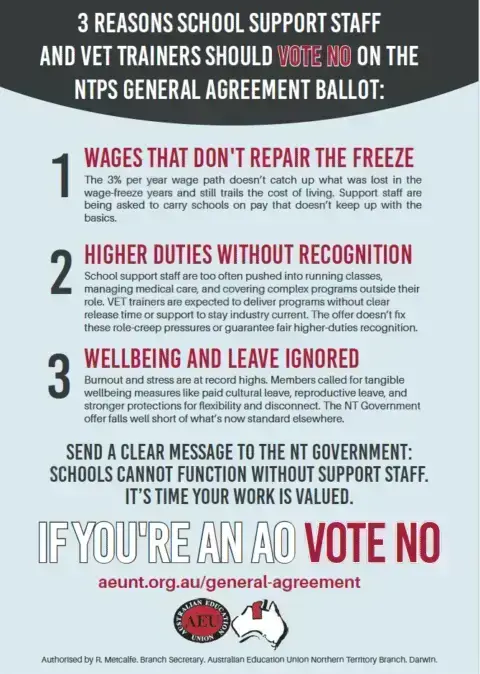
Flyer: Support Staff/VET Trainers should vote NO (NTPS General Offer Sept 25)

Click the images to download a printable PDF.

Once downloaded, you’re encouraged to print the PDF,s pin them to your union noticeboard (along with the Office Admin Flyer), and share them with staff on your site. Agreements covering NTPS employees give reps the right to use workplace facilities like printers and to consult with members and potential members. The OCPE’s Working with Unions guideline also confirms that distributing union material is permitted, provided it doesn’t disrupt normal work.

Please click the “Make an Enquiry” button to reach out to our office if you encounter any issues or if you would like to request any additional resources.

Support Staff (AEU) Flyer


2024 - 2027 NTPS Educators EA (under negotiation)

In-Principle Agreement Frequently Asked Questions

Log of Claims

CT Salary Table (In-Principle Agreement)

Old Level Oct-23 New Level Oct-24 Jan-26 Jan-27
+ 4.3% + 4.3% + 4.3%
CT1 84,191  PCT 87,812 91,587 95,526
CT2 88,414  CT1 92,215 96,181 100,316
CT3 92,638  CT2 96,622 100,776 105,110
CT4 96,860  CT3 101,025 105,370 109,900
CT5 101,083  CT4 105,429 109,963 114,691
CT6 108,073  CT5 112,720 117,567 122,622
CT7 112,297  CT6 117,126 122,163 127,416
CT8 116,519  CT7 121,529 126,755 132,205
CT9 120,742  CT8 125,934 131,349 136,997
 CT9 131,349 136,997 142,888

ST and PLO Salary Tables (In-Principle Agreement)

Please Note:

Although Senior Teacher (ST) and Principal salaries were not restructured in this agreement, we are committed to pursuing improvements in these areas outside of the enterprise agreement process, ensuring these roles remain competitive and attractive.

ST Salaries

Oct-23 Oct-24 Jan-26 Jan-27
4.30% 4.30% 4.30%
 ST1  $              133,553  $   139,296  $   145,285  $   151,533
 ST2  $              138,843  $   144,813  $   151,040  $   157,535
 ST3  $              147,568  $   153,913  $   160,532  $   167,435
 ST4  $              151,745  $   158,270  $   165,076  $   172,174
 ST5  $              162,235  $   169,211  $   176,487  $   184,076
 ST6  $              167,361  $   174,558  $   182,063  $   189,892
 ST7  $              173,291  $   180,743  $   188,514  $   196,621
 ST8  $              181,006  $   188,789  $   196,907  $   205,374


PLO Salaries

Oct-23 Oct-24 Jan-26 Jan-27
4.30% 4.30% 4.30%
 PLO1.1  $              135,192  $   141,005  $   147,068  $   153,392
 PLO1.2  $              137,897  $   143,827  $   150,011  $   156,462
 PLO2.1  $              138,843  $   144,813  $   151,040  $   157,535
 PLO2.2  $              143,008  $   149,157  $   155,571  $   162,261
 PLO3.1  $              147,568  $   153,913  $   160,532  $   167,435
 PLO3.2  $              154,947  $   161,610  $   168,559  $   175,807
 PLO4.1  $              160,453  $   167,352  $   174,549  $   182,054
 PLO4.2  $              165,266  $   172,372  $   179,784  $   187,515
 PLO5.1  $              170,911  $   178,260  $   185,925  $   193,920
 PLO5.2  $              176,038  $   183,608  $   191,503  $   199,737
 PLO6.1  $              181,354  $   189,152  $   197,286  $   205,769
 PLO6.2  $              186,795  $   194,827  $   203,205  $   211,943
 PLO7.1  $              191,319  $   199,546  $   208,126  $   217,076
 PLO7.2  $              197,058  $   205,531  $   214,369  $   223,587

Log of Claims with Outcome Reports

Click here to download a PDF version of this report:

24-27 NTPS Education EA AEU NT Log of Claims – Outcome Report

  Claim Outcome Details
Claim 01: Title Simplify the title of the agreement. Success Simplified title to “Northern Territory Public Sector Educators’ 2024–2027 Enterprise Agreement”.
Claim 02: Coverage Coverage to include Teachers, Assistant Teachers, and Principals.


Success Coverage includes Teachers, Aboriginal Team Teachers (formerly Assistant Teachers), and Principals (excluding those on Executive Contracts).
Claim 03: Period of Operation Seek a minimum two-year agreement, negotiable for longer depending on the wages offer and workload reduction. Success Agreement duration is three years and three months, expiring 31 December 2027.
Claim 04: Probation Waive probation if an employee transitioning from a fixed-term contract has already completed a process. Partial Success Clearer language for waiving probation if an employee has completed a similar process on a fixed-term contract.
Claim 05: Union Rights Guaranteed access to orientation events, communication channels, payroll deductions, and notifications for new employees. Partial Success Formal access to orientation events, guaranteed payroll deductions, and enhanced communication rights were secured, improving union visibility and helping members stay informed and maintain their membership. Full access to Department communication channels and new member notifications will be pursued in future agreements.
Claim 06: Types of Employment Clarify categories of employment (full-time, part-time, casual, and fixed-term). SUCCESS Clear employment categories (full-time, part-time, casual, fixed-term), bringing clarity and preventing misclassification.
Claim 07: Full-Time Employment A breakdown of hours for face-to-face teaching, non-contact duties, and professional duties. SUCCESS Detailed workload breakdown for full-time teachers, covering face-to-face teaching, non-contact time, and professional duties.This allows more transparency and less room for interpretation on the breakdown of hours.
Claim 08: Fixed Period Employment Ensure the employer provides a specific reason for fixed-term employment. SUCCESS Employer must specify the reason for any fixed-term employment. This brings more transparency and ensures that fixed-term contracts are used appropriately, aligning with the “Secure Jobs, Better Pay” amendments.
Claim 09: Stand Down Specify that new employees who haven’t accrued sufficient leave are still paid during stand-down periods. SUCCESS The agreement includes for the first time a full set of the long standing arrangements about pay over the Term break holidays.  Also includes provisions ensuring that where new employees have not accrued sufficient recreation leave they will be fully paid during the end of year school holidays
Claim 10: Casual Employment Align casual employment provisions with the National Employment Standards (NES) and include dispute resolution procedures. SUCCESS Alignment with National Employment Standards (NES), with casual employees now able to use dispute resolution procedures.
Claim 11: Relief Teacher Provisions-Pay Ensure payment for relief teachers includes full-day and half-day payments. Partial success Full and half-day payments for relief teachers; casual rates still based on CT1-CT3 tiers.
Claim 12: Relief Teacher Provisions- Casual Year Reduce the number of days required for relief teachers to complete one year of service from 195 to 180 days. SUCCESS The threshold for one year of service was successfully reduced from 195 days to 180 days, allowing relief teachers and part-time staff to progress more quickly in their classification and benefits.
Claim 13: Classifications, Salaries and Allowances Ensure salaries exceed CPI increases, better reflect experience level and are the highest in the country. Partial Success The 4.3% wage increase exceeds the current Darwin CPI of 3.2% (September 2024), ensuring real wage growth for members. Further increases of 4.3% in January 2025 and 2026 are expected to remain above inflation. Classroom teachers and Aboriginal Team Teachers received substantial pay increases through classification restructures, providing some of the best rates in Australia. There is also a commitment to review Principal salaries, with ongoing efforts to secure the same for Senior Teachers.
Claim 14: Salary-Based Allowances Confirm the application of the existing formula for salary-based allowances. SUCCESS The formula for salary-based allowances was confirmed.
Claim 15: Recovery of Overpayments Prevent the recovery of involuntary overpayments where the cost of recovery exceeds the overpayment amount. Not Successful The OCPE indicated that it would be outside the scope of their legislation to agree to this.

This will be included as a claim for the negotiations for a new NTPS General Agreement in 2025.

Claim 16: Classification of Employees, Classroom-Based Support Staff Introduce a classification structure for classroom-based support staff.   A commitment to review the classification of classroom-based support staff during the term of the agreement was achieved.This review is intended to assess the current roles and consider how they might be better structured and compensated.
Claim 17: Classification of Employees – Principal Determinations Incorporate permanent Principal provisions, including regular classification upgrades and clarifications around Emergency Shelter Management.   Principal classifications will undergo regular reviews, but responsibilities for Emergency Shelter Management remain unchanged. This issue will be addressed outside of Enterprise Bargaining with NTPFES and DoE.
Claim 18: Remote Incentive Allowance Increase remote allowance structures. Not successful Incorporating minor annual retention payments into the fortnightly Remote Incentive Allowance simplifies entitlements.
Claim 19: Remote Retention Payments Secure significant incentives for teachers to remain in remote areas. Not successful While large retention payments were not secured, modest increases were achieved for teachers in Alice Springs and Katherine. Our strategy focused on significant salary increases across the NT, with CT1s gaining over $8k/year and CT9s over $11k/year, which will compound and improve recruitment. This emphasis on long-term salary growth enhances NT’s competitiveness in attracting and retaining teachers. Additionally, work is ongoing with the Department on a “Hard to Fill” scheme and other recruitment strategies outside the Enterprise Agreement.
Claim 20: Remote Locality – additional provisions Provide free electricity and additional FOILS for employees in remote localities. Paritially successful While the Agreement does not mandate free electricity for remote staff, the Department will continue providing electricity in Category 2 and 3 areas and has withdrawn its claim for an electricity subsidy. A long-term solution to reduce electricity costs without financial impact on teachers is being pursued. Additionally, although no extra FOILs were secured, the Department agreed to offer additional compensation for travel through the under-utilised “End of Half Semester Travel” clause.
Claim 21: Parental Leave Increase partner leave and ensure paid special maternity leave. Not Successful The OCPE was unwilling to consider any adjustments to clauses that are common across all of the NTPS. This will be included as a claim for the negotiations for a new NTPS General Agreement in 2025.
Claim 22: Infectious Disease Leave Create a separate bank of leave for infectious diseases such as COVID-19. Not successful The OCPE was unwilling to consider any adjustments to clauses that are common across all of the NTPS. This will be included as a claim for the negotiations for a new NTPS General Agreement in 2025.
Claim 23: Emergency Leave Increase Emergency Leave from two to three days.. SUCCESSFUL Emergency Leave was increased from two days to three days, ensuring that employees have adequate time to manage unexpected emergencies without using other forms of leave.
Claim 24: Cultural and Ceremonial Leave Provide five days of paid cultural leave for Indigenous staff. Not Successful The OCPE was unwilling to consider any adjustments to clauses that are common across all of the NTPS. This will be included as a claim for the negotiations for a new NTPS General Agreement in 2025.
Claim 25: Non-Contact, Collaborative Planning Increase non-contact time and introduce days for collaborative planning. Partial success The Department scaled back their initial offer for NCT parity in order to fund the significant wage increases. This compromise was accepted based on feedback from members indicating that the teacher shortage needed to be addressed before further NCT increases could be implemented.

NCT for preschool, primary, and special education teachers will increase by 1 hour in 2026 and an additional 1 hour 20 minutes in 2027. Aboriginal Team Teachers will receive 2 hours of NCT per week. Although additional collaborative planning days were not achieved due to the gazetted school calendar until 2027, consultation on changes for 2028 and beyond will include member representation. Parity remains a goal for future agreements.

Claim 26: Teacher Responsibilities Include elements of the Teacher Responsibility Guide (TRG) in the agreement. Partial success Many of the elements of the TRG have now been included in the Agreement, however limits on meetings and duties still sit inside the TRG.
Claim 27: Class Sizes Reduce maximum class sizes, especially in special settings, and apply a workload weighting system for students with additional needs. Partial Success A firm maximum of 27 students per class has been set for NT government schools, with smaller class sizes for certain groups: 22 for preschool, an average of 25 for Transition and Years 11-12, and 16 for Intensive English classes. Although a student need-based weighting system was not secured, class sizes must still reflect students’ needs for workplace safety. If limits are exceeded, principals must consult with teachers in writing to manage the additional workload. Advocacy for minimum support staff provisions will continue outside the agreement process.
Claim 28: Disciplinary Proceedings Include a clause outlining processes for unsatisfactory performance and disciplinary actions. SUCCESS A new clause was introduced, ensuring a clear process for handling unsatisfactory work.
Claim 29: Agreement Reviews Incorporate recommendations from Workloads and Homeland Learning Centre reviews into the agreement. Partially Successful Some Workloads recommendations were adopted, with further improvements expected through the Workload Reduction Action Plan. The Assistant Teacher in Charge allowance for Homeland Learning Centres was amended to include Teachers in Charge, providing compensation for additional duties.
Claim 30: Authority to Teach Introduce a classification for employees teaching with a certificate from the TRB. SUCCESSFUL The agreement introduces the “Authorised Persons” classification for employees teaching with a certificate from the TRB, with transition arrangements for qualified existing staff. This ensures consistent conditions for “Authorised Persons” and recognizes the work of experienced teachers who mentor them.
Claim 31: Leave Entitlements/Accident Allowance Worker’s Compensation Ensure superannuation contributions and leave entitlements accrue during workers’ compensation. Not Successful The OCPE was unwilling to consider any adjustments to clauses that are common across all of the NTPS. This will be included as a claim for the negotiations for a new NTPS General Agreement in 2025.
Claim 32: Language Allowance Provide a language allowance for employees using non-English languages in their roles. Not successful The OCPE was unwilling to consider any adjustments to clauses that are common across all of the NTPS. This will be included as a claim for the negotiations for a new NTPS General Agreement in 2025.

(A Joint Unions/OCPE Review off this is presently on-going.)

Claim 33: Break Times Include specified break times in the agreement. SUCCESSFUL Break times are now included, providing accountability for their provision.
Claim 34: Senior Teacher Release Create a framework for Senior Teacher release from teaching duties. Not Successful We did not achieve any improvements to ST release, nor did we achieve a framework. We will continue to pursue this outside of the enterprise agreement process.
Claim 35: Review of Homelands: Locality Provisions Ensure all staff at Homelands Learning Centres receive Category 3 remote provisions, regardless of personal residence. SUCCESSFUL Staff working a minimum of three days per week at specific Homelands Centres are now eligible for corresponding remote provisions.
Claim 36: Inclusion of Determinations Incorporate relevant Commissioner’s Determinations into the agreement. SUCCESSFUL All relevant Determinations have now been incorporated into the agreement, making it much simpler for employees to find and understand their entitlements without having to look across multiple documents.
Claim 37: Reproduction Leave Introduce reproductive leave for menstruation, menopause, and related issues. Not Successful The OCPE was unwilling to consider any adjustments to clauses that are common across all of the NTPS. This will be included as a claim for the negotiations for a new NTPS General Agreement in 2025.
Claim 38: Technical Amendments Make technical amendments required due to legislative changes. SUCCESSFUL This has occurred across the agreement as required.
Claim 39: Long Service Leave Weekends Allow long service leave to be taken without needing to include weekends. Not Successful The OCPE were unwilling to consider this as Teachers already have some of the best Long Service Leave entitlements in the NTPS. You can find out more about this in our Guide to Long Service Leave.
Claim 40: Compensation for Additional Duties Provide compensation for additional duties, such as supervising students beyond normal school hours. Not Successful This is something that we will continue to pursue in further agreements.
Claim 41: HALT Review and improve HALT provisions.   Although there are no improvements to HALT provisions in the agreement, this is an element of the Better and Fairer Schools Agreement with the Federal Government for funding increases. As such, discussions will continue outside of the Enterprise Agreement process.
Claim 42: School-Based Corporate Deployment Ensure office-based employees earn TOIL when deployed to schools. SUCCESSFUL The agreement allows office-based staff to earn 1 day of TOIL for every 12 days worked in schools. TOIL can accumulate over multiple deployments without any time limit between them, but once earned, it must be used within 3 months.

FAQs NTPS Educator's Enterprise Agreement 24-27 (Ballot)

Log of Claims (2024-27 NTPS Educator's Enterprise Agreement Negotiations)

AEU NT Log of Claims

Australian Education Union NT proposals for a replacement NTPS Non-Contract Principals,  Teachers and Assistant Teachers’ 2021-2024 Enterprise Agreement

Claim 01: Title Agreement to be called the Northern Territory Public Education Agreement
Claim 02: Coverage Coverage rules to include:

Teachers

Assistant Teachers

Principals

Claim 03: Period of Operation The AEU-NT seek a minimum two-year agreement. Negotiable for longer dependant on wages offer and real action to reduce workload.
Claim 04: Probation Clarity where an employee has been on a fixed term contract for a minimum of six months and offered ongoing, the probation period will not apply.
Claim 05: Union Rights Clause 25 is amended so the AEU-NT has:

Guaranteed and formalised access to orientation events.

The right to use DoE mass communications to communicate with members and potential members.

Notification of new employees.

Guaranteed access to payroll deductions for all DoE and school council staff.

Claim 06: Types of Employment Clause 28 is modified to reflect the award and specify an employee is employed in 1 of 4 categories. Full-time, part-time, casual, or fixed term.
Claim 07: Full-Time Employment A teacher’s workload is broken down and specifies the quantum of hours for face-to-face teaching, non-contact duties and professional duties. Part-Time provisions are pro-rated.
Claim 08: Fixed Period Employment Clause 28 is amended to be reflective of the secure jobs, better pay amendments and reflective of award provisions that specify a reason for fixed term appointments.

Where an employee is employed on a fixed-term basis the employer will specify a reason for the fixed term employment.

Claim 09: Stand Down Specifying Stand Down to ensure where new employees have not accrued sufficient leave stand down is paid for the remaining recreation leave period. Plus other arrangements as per (OCPE ER Advice 0049)
Claim 10: Casual Employment Clause 31 is amended to not only make reference to National Employment Standard but also to be subject to dispute resolution procedures.
Claim 11: Relief Teacher Provisions-Pay The payment for relief teachers is reflective of award and specifies full day and half day payments. The casual rate is calculated using CT4.
Claim 12: Relief Teacher Provisions- Casual Year Reduce the 195 days to allow for casual staff to be counted as full-time to 180days.
Claim 13: Classifications, Salaries and Allowances Salary increases must ensure that all roles covered are “the best paid in the country” over the duration of the agreement, and reflect the time spent obtaining professional qualifications.


Special consideration should be given to ensure experienced teacher, senior teacher and principal salaries are reflective of their experience and responsibilities.


Annual percentage increases to salaries and allowances should reflect CPI increases, at a minimum.


Claim 14: Salary-Based Allowances Confirmation the formula in Clause 33.2 applies to salary-based allowances as well.
Claim 15: Recovery of Overpayments NT Financial Management Regulations 1995 require amending to facilitate the inclusion of provisions that prevent recovery from an employee of involuntary overpayments where the cost of the recovery process exceeds the amount to be recovered.
Claim 16: Classification of Employees, Classroom-Based Support Staff A classification structure for classroom-based support staff (Educational Officers) to be introduced covering para-professional educators.
Claim 17: Classification of Employees – Principal Determinations Incorporation of Permanent Principal provisions of Commissioner Determinations. Including consideration of “Restriction Duty” for Principals on leave but required for Emergency Shelter management and/or other non-educational duties.


A commitment to regularly upgrade Principal classifications in a timely manner to ensure that they accurately reflect the complex nature of their schools.


Claim 18: Remote Incentive Allowance Increases to offer competitive remote allowance structures.
Claim 19: Remote Retention Payments Remote Retention Payments offer significant incentives for teachers to remain
Claim 20: Remote Locality – additional provisions Free electricity provision to all employees in remote localities.

An entitlement of four FOILS for employees stationed in category 3 remote areas.

Claim 21: Parental Leave Partner Leave to be increased to four weeks for less than 12months service and 6weeks for greater than 12-month service.


All special maternity leave is to be paid and access to primary caregiver parental leave entitlement is given in all circumstances where there is loss of a child.

Claim 22: Infectious Disease Leave Specify infectious leave is a separate bank of non-cumulative leave per calendar year.

Include a clause specifying viruses such as COVID-19, Ross River Fever and other future diseases classified as pandemic/epidemic.

Claim 23: Emergency Leave Emergency Leave restored to 3 days akin Common Clauses of the other EAs and the By Law.
Claim 24: Cultural and Ceremonial Leave Provide 5 days of paid cultural leave for indigenous staff
Claim 25: Non-Contact, Collaborative Planning Teaching professionals and   paraprofessionals receive an increase   to autonomous release time scheduled during the timetabled hours of a school   day; which is adequate to meet the professional requirements involved in the delivery of teaching and learning expectations as set out in clause 10.4.


Including but not limited to:

Primary teachers to be given at least 5hrs 20min.

Allocation of release time for Assistant Teachers

Provision of collaborative planning days


Further note of wording tweak to ensure no misunderstanding of intended NCT for teachers of secondary aged students in remote schools listed in Schedule 5.3.1

Claim 26: Teacher Responsibilities That elements of the TRG that are directive (e.g. face to face teaching, supervision duties) are included in the agreement – and the broader contextual factors form part of the teacher responsibility guide.
Claim 27: Class Sizes Reduce the number of students enrolled in a mainstream Primary or Secondary Class to a maximum of 24.


This includes making a mandatory adjustment using a weighting system for class size calculations, which recognises the workload involved in teaching students with additional needs who require substantial learning adjustments.


That maximums apply to the following:

Special Education Centre classrooms (Max 6)

Intensive English classrooms (Max 12)

Pre-School (ratio of educator to students of 1:11 as per regulations)


Support staff provided for a minimum of four hours per day for all primary classes.


Further staff allocations are provided based on student weightings.

Claim 28: Disciplinary Proceedings A clause outlining process for unsatisfactory work and disciplinary proceedings.
Claim 29: Agreement Reviews Where applicable the recommendations of the non-contact times; and administrative burdens on teachers is incorporated into the agreement.


Where applicable the recommendations of additional duties of Homeland Learning Centres is incorporated into the agreement.

Claim 30: Authority to Teach Conditions specific to Authority to Teach are implemented based on further discussions with those implicated.
Claim 31: Leave Entitlements/Accident Allowance Worker’s Compensation Super contribution to be made and Leave entitlements accrue while employees are on Workers Compensation. NB: Clause 48 – “Accident Allowance” of the General EA
Claim 32: Language Allowance A language allowance to be received by employees where utilising a non-English language is relevant to their role. (See Determination Number 6 of 2013 Community Language Allowance.)
Claim 33: Break Times The inclusion of break times in the agreement.
Claim 34: Senior Teacher Release Positions of Responsibility have a framework for assessing ST salary modelled off award and include a minimum release from teaching duty.
Claim 35: Review of Homelands: Locality Provisions Staff working at Homelands Learning Centres receive Category 3 remote provision as a minimum regardless of the location of their personal residence or office.
Claim 36: Inclusion of Determinations Incorporation of all Commissioner Determinations. Includes:

Alice Springs Relocation Allowance,

Katherine town Relocation Allowance,

Alice Springs Retention Allowance,

Katherine town Retention Allowance,

Satellite TV or Internet Service Reimbursement 1014/2022

Household Content Insurance Premium 8/2015

Leave arrangements for teaching staff employed at Tivendale, Owen Springs & Sanderson

After Hours Higher Education Loan Program Reimbursement

Claim 37: Reproduction Leave An additional leave clause for Menstruation and Menopause Leave under the umbrella of “Reproductive Leave”.


Minimum 5 days non-cumulative Reproductive Leave days per annum be available to workers experiencing the symptoms of menstruation (including pre- menstrual issues, menopause (including perimenopause) and other reproductive health related issues. This leave is to be in addition to paid personal leave entitlements and does not require them to be exhausted before accessing this new entitlement.


Partners: a number of equivalent days that are accessible to them if needed to provide support (physical or psychological) and/or to attend appointments related to reproductive health of their partner.

Claim 38: Technical Amendments Any technical changes to other clauses that arise from agreed changes. Technical amendments that are required due to legislative requirements.
Claim 39: Long Service Leave Weekends Ability to access long service leave in non-restrictive increments; inclusive of and not limited to 1-day usage and without the requirement to include non-working weekend days.
Claim 40: Compensation for Additional Duties Staff to be given time in lieu and reimbursement for additional duties undertaken that require them to supervise students beyond normal school hours.
Claim 41: HALT Conditions specific to HALT are reviewed and implemented based on further discussions with those implicated.
Claim 42: School-Based Corporate Deployment Pro-rata school-based conditions and allowances for redeployed corporate staff.


Key Guides

Guide: Teacher Responsibilities

It may be called a ‘Guide’, the contents of the Teacher Responsibilities Guide (TRG) is a mandatory resource for leadership teams in NT schools to consult and work within. This is because its wording is agreed between AEU NT and DoE. It is also referenced in the Teachers, Assistant Teachers’ and Non-Contract Principals Enterprise Agreement. This makes it enforceable. However, AEU NT will always advise members to engage in genuine consultation that is offered and to work with school leadership teams to reach mutually beneficial negotiated outcomes as much as possible.

We encourage you to download the Guide here and ensure it is available both on your union noticeboard and more widely for all staff.

Available online at Teacher Responsibilities Guide

Professional Growth as Protection

The evidence across Australian jurisdictions and internationally is clear: to keep teachers healthy and teaching reducing their workload must be a priority in every system. In the year ahead, we will have an opportunity to, once again, move the industrial levers we have in the NT on teacher workload to try and reduce maximum class sizes and increase non-contact time when we go back into enterprise bargaining. The other piece of work already underway at the Department, closely monitored by AEU NT, is the Teacher Workload Review Project, with a focus on things that can be done now and are in the Department’s and its schools’ control. More to come on this important work as the year develops!

The primary purpose here though is to promote two vital pieces of teacher, support staff and other employees paperwork that, despite the keenness of some to dismiss or ignore it – do have to continue.

Incident and accident reporting

All employees have a responsibility, set out in policy, and underpinned by work health and safety legislation, to report any accidents, incidents and near misses involving them. By recording, monitoring, and investigating incidents, we can learn and put in place measures or changes to prevent them from happening again.

AEU NT and the Department know there is already an under reporting of actual incidents, and that each unreported event is a learning opportunity lost.

Every employee, student or visitor who arrives at a school deserves to leave as fit and healthy as when they arrived. So, it is up to everyone to record incidents, both for themselves and everyone else.

Professional growth plans (PGPs)

Since their introduction in 2019, the current Department ‘staff performance management’ measure of PGP’s has been increasingly taken up but, notably, this has not happened everywhere in the NT’s system. With work pressures increasing, AEU NT is concerned they may be seen as optional by some.  It is important to note they are underpinned by clause 79, Staff Performance Planning and Review of our Enterprise Agreement.

Both managers and employees are expected to engage constructively in the PGP process. Most of the time, when PGPs are approached in the manner suggested in clause 79, they provide a positive space for teachers to reflect on current practice and career goals then authentically use the results for professional development. They also serve to reduce misunderstandings and misperceptions of performance that do occur and, if left to fester, can prove far harder to debunk later and significantly erode workplace relationships. Smart school leaders accept personal responsibility for making sure their school has a strong culture around PGPs.

Thus, PGPs provide protection for both teachers and school leaders from falling into a position where underperformance is present, potentially leading to the formal Managing Underperformance Procedure (MUP). Beware that failing a MUP invariably leads to a teacher losing their job, in turn leading to a referral to the Teacher Registration Board and, ultimately, a possible loss of registration. In short, a MUP can be a career-killer.


Downloads

Performance-Growth.pdf

Guide: Non-Contact Time

What is Non-Contact Time (NCT)?

Non-contact time is for the teacher to prepare, plan, assessment and correction without the need to supervise children. It can also be referred to as release time.

How much NCT do I get?

Pre-school teachers with a full teaching load are entitled to one session a week, which should equate to 3 hours.

Primary school teachers with a full teaching load receive a minimum of 3 hours per week. This includes teachers in settings such as special schools, units and annexes, intensive English units, gifted units as well as specific purpose units and classes.

Secondary teachers with a full teaching load in colleges, high schools and area schools received a minimum 5 hours and 20 minutes.

Graduate teachers will have an additional hour on non-contact time per week.

Wherever possible, school administrators will program up to 5 corresponding hours of non-contact time per semester for teachers assigned to a graduate teacher as a mentor.

Senior Teachers are allocated non-contact time on a pro-rata basis according to their teaching load.

Teaching Principals are entitled to 5 hours and 20 minutes non-contact time.

What if I am part time?

Classroom Teachers employed on a part-time basis will receive non-contact time pro-rata to their teaching load. If you are employed in a part time capacity to facilitate the provision of non-contact time for other classroom teachers then no entitlement applies.

How is NCT allocated?

This will be allocated to you on the school timetable and may be different between schools. When it is being allocated, it should be in useable blocks of time, for example not less than 30 mins.

What if I am a casual or relief teacher?

Casual teachers are not entitled to NCT.

What about supervised eating time?

Supervised eating time is considered instructional time and not part of NCT.

What if my NCT time is being overridden with other school demands?

Teachers have flexibility to use their non-contact time to achieve required outcomes and this time is generally for the administrative activities associated with teaching. If you are being allocated work to do in this time, have a discussion with your line manager. If people are setting meetings for you to attend in that time, respectfully ask them to consult with you first. Effective consultation involves more than a mere exchange of information. Employees must be contributors in the decision-making process. Visit Safe Work Australia for more about consultation and what it means in practice at https://www.safeworkaustralia.gov.au/doc/model-code-practice-work-health-and-safety-consultation-cooperation-and-coordination

What about personal appointments?

When planning personal commitments teachers are expected to take account of their professional obligations. Similarly, principals are also expected to consider professional and personal obligations in scheduling meetings and other activities at which teacher attendance is required.

What if I am not getting my NCT?

Non-contact time can be averaged over a 2-week period. Keep a record of the amount of non-contact time that you receive each fortnight. If this continually shows that you are not being allocated your minimum amount of non-contact time and your principal has not planned with you to remedy the situation, then call the office and ask for advice.

Your NCT is important and an entitlement. It exists to help balance your workload and personal responsibility. You should not accept anything less than the minimum time as set out in the Teacher Responsibilities Guide. If you do, you are potentially masking an issue to do with understaffing and placing greater pressure on yourself and your colleagues.


Links

Downloads

Guide-to-Non-Contact-Time.pdf

Commissioner’s Guidelines: Working with Unions

We are your first line of support if there’s an issue at work, whether it’s a dispute over your pay, a conflict with a supervisor or a workplace injury. As a collective body, we campaign for stronger laws, policies and agreements to support teachers and the public education system. To achieve this, we must have a constructive working relationship with the NT Department of Education and the Department of Corporate and Digital Development (DCDD).

Read the Guidelines at Commissioner’s Guidelines for Working with Unions.

Role of a Support Person

Must I Meet with my Manager?

A fact of working life is that just about everyone at some stage is going to have to deal with a formally convened meeting with their (often) senior manager. Teachers and other educators are no different. Such meetings might be about already documented underperformance or inability but, more likely in our setting, they will be about a workplace incident or around allegations that have been received about you.

Longtime teaching career veterans of the AEU NT estimate that an individual teacher will hit a “patch of hot water” on average, about every 10 years. But you still have rights (from common law) and, more often than not, the opportunity to explain facts and provide evidence resolves the issue in a constructive way.

How to find out about those common law rights and what to expect in any investigation process will be one of the reasons many of you are union members, so read on.  And if you are a sub-branch rep read on and keep as you will often be the best placed person to support a summoned member.

Modernised guidance to all the NT public service (NTPS) on the role of a support person was finalised in 2021. The Guideline might be called “Guidance” but it’s from the big boss so it is to be followed and gives members and those seeking to assist them, much more clarity about how meetings should be conducted, allowing those members in the hot seat to better focus on the substance of why they are there.

Key elements of the current Guidelines include:

  • Employees must be provided the opportunity to bring a support person.
  • Recommended notice period for meetings is 48 hours.
  • Employees to be advised of all those attending the meeting.
  • Advance provision of either an agenda or the specific purpose for the meeting.
  • Recognition that a support person need not be a silent witness.
  • Information about what can and can’t be done in their role.
  • Meeting notes to be provided after the meeting is concluded.

AEU NT is pleased to have found that these guidelines are largely being closely followed by all managers, principals, and directors of the Department of Education. It should only be in extremely rare cases involving the most unusual and heightened of circumstances that this role will vary.

You will note in the Guidelines that support persons are not to advocate or ‘story tell’ for the employee they are supporting. However, there is a straightforward work-around this office has been successfully using and that sub-branch reps might utilise where they need to. The ‘limited’ support person role only applies when managers call meetings, not when union officers or sub-branch reps request a meeting with managers.  Thus, if AEU believes there must be active advocacy in a particular matter, we will request co-extensive meetings, providing an agenda, with the same manager, who summons our member.  This means that, in practice, we will begin a meeting and cover the manager’s agenda, acting as a support person.  Once that is completed, we will move into our own agenda items and provide advocacy.

Finally, please note, the AEU office regularly briefs members and sub-branch reps who are about to become a support person in a particular member’s matter. Do feel free to seek our advice and some handy tips.


Links

Role of a Support Person: Commissioner’s Guideline

Downloads

Role-of-a-Support-Person.pdf

Pay & Hours

Lost NCT - Compensation

Teacher Working Hours

The myth of 4:21

The AEU NT office receives regular enquiries about when teachers are allowed to finish work and go home for the day. Often the inquiry is based on a directive teachers have received from their principal that they need to be present at work until an arbitrary time such as 4:21pm. More often this is a result of management inexperience or a lack of understanding about teachers’ working conditions and entitlements.

Unlike most public servants, teachers do not have a specified “span of hours”. This is acknowledged in the NT public sector modern award, which states that the span of the ordinary hours of a public servant “do not apply to Assistant Teachers, Classroom Teachers and Senior Teachers”. For office-based public servants, those who work outside the ordinary span of hours (typically 7.30am to 5.30pm, Monday to Friday) can either accrue time off in lieu or receive overtime or penalty rates. None of these provisions apply for teaching staff.

Length of the working day

Like other public servants, teachers do have a notional working week of  36 hours and 45 minutes, however it is only for administrative purposes that the notional 7 hours and 21 minute working day applies, for example, in the accrual and use of personal and recreation leave.

The length of time teachers are required to be on site each day is governed primarily by the requirements of providing instruction and care to students. NT public schools must provide a minimum of 5 hours and 20 minutes instruction time to students each day. This adds up to a weekly requirement of 23 hours and 40 minutes per week of face-to-face teaching time for a full-time employee, minus that teacher’s assigned non-contact time (NCT). The remainder of a teacher’s working day is made up of meeting other professional and pastoral care responsibilities.

Because no guide or agreement specifically states what hours a teacher must work, the hours a teacher can work is not well-defined, which can lead to misunderstandings such as principals directing teachers to remain on-site until 4:21pm. However, in most circumstances, once a teacher has discharged their duties for the day including any duty of care responsibilities, they are able to leave the worksite.

What are start and finish times for teachers?

The fact that teachers do not have a defined span of hours has several implications. Firstly, aside from the requirement to be at school 10 minutes prior to their first lesson, teachers don’t have a specific start or finish time. Secondly, teachers working with students at camps, after school or on weekends cannot claim anything as overtime or time off in lieu. It also means that teachers can be expected to work out of usual hours, within reason. An example of this is parent teacher interviews.

The Teacher Responsibilities Guide

The most detailed guide to working conditions for teachers is the Teacher Responsibilities Guide (TRG). Being an addendum to the enterprise agreement, it is referenced in the agreement and is enforceable. Both the Department of Education and the AEU NT often refer to this guide as the most definitive source of information concerning working hours and teachers’ conditions of employment. In the TRG, a key feature is its definition of the responsibilities that a teacher must fulfill in the course of their normal duties. Those responsibilities include classroom instruction, lesson preparation, school assemblies, pastoral functions and professional development.

As there is no span of hours for a teacher, the TRG gives reasonable discretion to the individual teacher to discharge their duties – other than timetabled face-to-face teaching and rostered meetings and supervision – as they see fit. This extends to non-contact time, which teachers should be able to use discretion in how they make use of, rather than being directed to undertake specific tasks during this time.

What is the employer’s position?

A former Commissioner for Public Employment, Craig Allen, wrote to the AEU NT regarding OCPE’s position on the end of the working day. His response:

“Hours of work provisions are in the Teacher Responsibilities Guide … It covers a range of matters including contact hours, non-contact hours and other duties such as staff meetings etc. There isn’t a direct a span of hours for teachers in schools given the nature of their work … Provided a teacher is available to teach his or her allocated classes and perform other duties during school operational hours, they are able to quit the campus when students are discharged for the day … The occasional request for teachers to stay back until 4.21pm to attend a staff meeting or other work-related activity would be reasonable, and I suggest within the responsibilities guide.  On the other hand, a principal insisting on teaching staff remaining on campus until 4.21pm for no reason may be unreasonable.”

Therefore, the requirement for teachers to remain on site at the end of the school day should be based on reasonable grounds and subject to consultation. There are some specific instances where teachers may be required to remain at school. The TRG specifies that teachers are required to attend one after school staff meeting or equivalent  once per week, and additionally once per semester to make themselves available for parent teacher interviews out of hours. More can happen, but only with genuine consultation.

Why has this unique set of arrangements developed?

This arrangement suits both teachers and the employer as it affords flexibility in how work demands are met. AEU NT experience shows that the overwhelming majority of teachers typically work far more than the standard 36 hours and 45 minutes for which other public servants are paid, working extensively in the evening and on weekend. Therefore, the focus should be on ensuring teachers are supported to perform their duties in a flexible manner, rather than insisting on rigid starting and finishing times. Variation of workday patterns at a school level must only take place after genuine consultation has occurred with members of the union sub-branch, and, if necessary, our office.

Download: The myth of 4.21pm – Guide to teachers’ working hours FAQ.pdf

Teacher responsibilities guide (education.nt.gov.au)

Guide: Classification Levels

How are teaching salaries and allowances set?

Salaries and allowances for teachers are covered by an enterprise agreement negotiated between the AEU and the employer (Office of the Commissioner for Public Employment, and the Department of Education).

How are teachers classified for salary purposes?

Classroom Teachers are classified in increment levels CT1—CT9.  Teachers progress annually to CT9.

Classification Level          Amount

CT1……………………………….84 191
CT2………………………………88 414
CT3………………………………92 638
CT4………………………………96 860
CT5………………………………101 083
CT6………………………………108 073
CT7………………………………112 297
CT8………………………………116 519
CT9………………………………120 742

What about casual Relief Teachers?

Relief teacher hourly rates are divided into three tiers based on years of teaching experience. One day of relief teaching = 6 hours.

Tier                                $ amount per hour

1  (less than 3 yrs)……..67.25
2  (3 to 6 yrs)…………….70.62
3  (6+ yrs)…………………73.99

What about Senior Teachers?

Senior teachers are promotional and managerial positions that are renumerated above the normal CT scale. In order to progress up this scale you need to seek and win a promotion.

Classification Level     Amount

ST1………………………………133 553
ST2………………………………138 843
ST3………………………………147 568
ST4………………………………151 745
ST5………………………………162 235
ST6………………………………167 361
ST7………………………………173 291
ST8………………………………181 006

Do Assistant Teachers have increment levels?

Yes, levels AT1—AT5. Assistant teachers are Indigenous staff employed to assist with teaching   programs in the classroom, who undertake further study as a condition of employment.

Classification Level     Amount

AT1………………………………56 455
AT2………………………………61 486
AT3………………………………65 860
AT4………………………………72 831
AT5………………………………78 511

Are there higher classroom teacher increment levels?

HALT is a nationally recognised certification of teachers wishing to demonstrate classroom practice beyond the proficient standard. In the NT, a Highly Accomplished or Lead Teacher Allowance is paid fortnightly in additional to a CT salary. The allowance for a HAT is $12 812 and for an LT it is $26 828.

What additional teaching allowances are there?

There are several kinds of allowances for teachers. An Application for Teaching Allowance Form must be completed before the allowance can be paid and must be renewed at the start of each year.

Allowance                                                               Amount

Teacher in a special school/class………………………..3340
Teacher in charge pre-school with 2 teachers…….7148
Teacher in charge pre-school with 1 teacher………3455
Assistant teacher in charge of homeland school…1626

What other types of allowances are payable under the EA?

In addition to salary, the following allowances may be applicable.

Remote incentive allowance:

This is a taxable allowance paid to remote-based CTs, STs, ATs and ongoing principals in recognition of isolation and freight costs.

Category Rating         Single               Dependent
Special………………….1391……………..1735
1…………………………..4627…………….5646
2…………………………..5400……………6586
3…………………………..8486……………10348

Remote retention payment:

This allowance is paid to employees in remote locations after each 12 months of continuous service.

Remote Category            Amount

1…………………………………..500
2………………………………….750
3………………………………….1000


Downloads

Guide-to-Classification-levels-Salaries-and-Allowances.pdf

Leave & Allowances

Guide: Long Service Leave

What is Long Service Leave?

Long Service Leave (LSL) is a period of additional paid leave granted to employees who have completed an extended period of service with an employer. This entitlement is rather unique to Australia, with only a few other countries having a similar employee benefit. In the Northern Territory, LSL accrues after 10 years of continuous service.

Entitlement

Long Service Leave is set out in By-law 8 of the Public Sector Employment and Management Act (PSEMA) managed by the Office of the Commissioner of Public Employment (OCPE).

A full time employee’s entitlement is three (3) calendar months after completing 10 years of continuous ser-vice, where a month is counted as 30 days. This means an employee accrues 90 calendar days (65 working days) after 10 years of continuous service working full time.

The LSL entitlement in the NT is one of the longest in the country with only South Australia being equal. Other jurisdictions receive 8.67 weeks (meaning 60.69 calendar days; 43.35 working days) or less at 10 years of service.

Weekends

Long Service in the private sector is governed by the NT Long Service Leave Act 1981 and accrues at 1.3 weeks per year of service for a total of 13 weeks (65 working days) at 10 years.

The Northern Territory Public Service (NTPS) uses calendar days because the nature of so many of its employees work shifts, overnight, weekends and have rostered weeks off (e.g. nurses, fire fighters). That is why LSL is counted to include a weekend. Daytime weekday-only workers (e.g. teachers) are not losing any entitlement, it just makes it simpler to manage a public service wide system.

Using your LSL

Any employee is required to use LSL within three years of their 10 year entitlement and 20 year entitlement accruing. Your employer can direct you to take this entitlement. You can take your LSL at full pay or half pay, doubling the time you can take off. (Note: If you do take LSL at half pay it ‘slows’ your accrual of Recreation Leave and Personal Leave).

LSL is intended to provide lengthy breaks from work. Permission to undertake secondary employment whilst on LSL is limited. Seek further union advice.

Unlike other NTPS employees, teachers and other school-based employees have the option to take LSL for periods of 3 days. This fact, along with the higher level of NT LSL, means NT teachers and school-based AO’s have the best LSL arrangements in public education systems across Australia, and arguably many other industries/sectors.

Continuity of Service

Rules on continuity of service means you can have a break/period outside of teaching of no greater than 12 months before you break continuity. However, unpaid personal leave, full-time union duties with a union representing public service employees, and defence service leave will not break continuity of service if you are absent for longer than 12 months. Workers Compensation will also not break continuity of service but does not count as service.

Recognition of Prior Service

The Northern Territory Government counts work with “recognised employers” as counting towards service. A recognised employer for our context is, e.g. any work performed with a state education department in Australia. You can apply to have prior service recognised once you have completed 2 years of employment with NTPS.

A full list of recognised employers is contained in Determination 9 of 2025 Please note that Charles Darwin University and Batchelor Institute are also included.

Allowances

While on LSL, employees are entitled to their ordinary salary in relation to their designation. If the employee is on approved allowances (e.g. HDA) and those allowances span the course of the LSL, the employee will receive the allowances for the entire period of leave. However, if their allowance/s cease within the LSL period, they will only be paid up to the approved period. Other allowances that are altered whilst on LSL are teaching allowances, Northern Territory Allowance, Remote Incentive Allowance and Remote Retention Allowance.

December/January leave period: This period will be deemed as recreation leave as it is the only period in which teachers may utilise their recreation leave entitlement.

Payments before 10 years

Employees are eligible for payment in lieu on cessation of employment at one (1) year of service where they have retired, ceased on or after attaining 55 years of age, on redundancy, or on death.

Employees are also entitled to payment on resignation after completing seven (7) or more years of service. You receive 22.5 calendar days at seven years, 45 calendar days at eight years, and 67.5 calendar days at nine years.

Illness during LSL

If you fall ill during your LSL and have medical evidence the CEO may grant personal (sick) leave and re-credit your LSL to use another time.


References:
Office of the Commissioner of Public Employment By Law No. 8 : https://ocpe.nt.gov.au/

Downloads:
AEU NT Guide to Long Service Leave (PDF)

Guide: Parental Leave

Who can access parental leave?

Full-time, part-time and eligible casual employees are entitled to parental leave if the leave is associated with:

  • The birth of a child by you or your spouse,
               including by surrogacy arrangement.
  • The placement of a child  for adoption
  • The placement of a child under a long-term or permanent care order and you have, or will have, responsibility for care of the child.
Eligible casual employee means a casual employee who has been engaged by the employer on a regular and systematic basis for a period of:
  • At least 12 months
  • Less than 12 months, provided that the employee has undertaken a previous engagement with the employer and;
a) the employment was terminated
b) the employee was re-hired within 3 months of previous termination and the total period of employment is at least 12 months.

How much parental leave can I access?

Primary carers can access paid parental leave after anywhere between 39 weeks and 12 months of continuous service.

Partners can access paid parental leave after at least 12 months of continuous service. See tables p.48 of NTPS Teachers’ 2021-2024 EA.

Can I take leave at half pay?

Yes, you can elect to take a longer period of time on half pay. A period of parental leave does not break an employee’s continuity of service.

My partner and I are both NYPS employees. Can we combine our leave?

Yes, provided you satisfy the service requirements and notice periods as well as evidence requirements. You must both apply for the respective parental leave periods and there is a maximum of two interchanges during the combined leave. The combined paid and unpaid leave must not extend beyond 3 years from its commencement.

How much notice do I have to give?

Written notice of at least 10 weeks is required relating to the intention to take parental leave and the

proposed start and end dates. This must be confirmed in writing 4 weeks prior to intended commencement date or advising of any changes to dates. You must also provide a statutory declaration stating you will be the primary caregiver (for parental leave). If there are unexpected circumstances relating to the birth, then providing this information at your earliest convenience is acceptable.

What if I don’t feel safe at work during my pregnancy?

If there are hazards connected to the work you are expected to perform, there is a provision to be transferred to a safe job during the risk period, if it is available and reasonably practical. This may include a medical issue arising from pregnancy and will need an accompanying medical certificate.

Can I access other leave while on parental leave?

Yes, you may access accrued recreation leave and long service leave entitlements during a period of unpaid parental leave. However, this will not extend the maximum period of parental leave.

Can I work while on paid parental leave?

Yes, but it will not extend the maximum period of parental leave and employment outside of the NTPS is subject to the requirements of the PSEM Act. You can work within the NTPS when on unpaid parental leave within your agency or another agency.

‘Keeping in Touch Days’ are a provision allowing you to attend your workplace for meetings and training during parental leave to help facilitate a return to work and to familiarise you with any changes in the workplace. These will be paid days or part days.

What about returning to work?

If you elect to return to work in the 6 weeks immediately following the birth, a medical certificate is required stating your fitness for work. If you are returning to work early from a period of parental leave, you must provide an application to return to work. If your leave has been less than 1 year, then you need to make the request at least 4 weeks prior to your preferred date. If your leave has been longer than 1 year, you need to make the request with at least 12 weeks’ notice.

Will I get my old job back?

Yes, you are entitled to the position that you held immediately prior to leave, however if that position no longer exists, then you will be placed in a position of similar pay and status.

What about superannuation contributions?

Employer superannuation contributions will be paid during the first 12 months of parental leave as if you had been at work. The superannuation contributions must be paid during periods of both paid and unpaid leave, not in a lump sum at the end.

Should you elect to take any paid leave at half pay, superannuation contributions will be made during the half pay period as if the leave was taken at full pay.

NOTE: the double superannuation contributions under clause 52.16 b) will only be paid for a period that is equivalent to utilising paid parental leave at full pay. For example, if 14 weeks paid parental leave is taken at half pay over a 28-week period, then the double superannuation will only be paid for the first 14 weeks.

What if I get pregnant again?

You can elect, subject to notice and evidence requirements to commence another period of parental leave relating to a subsequent child as soon as your pregnancy is confirmed.

See Table A & B on our downloadable fact sheet for more detail.

Reference: Northern Territory Public Sector Principals, Teachers and Assistant Teacher’ 2021-2024 Enterprise Agreement pg. 46-67


Downloads

Quick-Guide-to-Parental-Leave.pdf

Role Conditions

Assistant Teachers

Assistant Teachers play an essential role within our Northern Territory Education system.

ATs are Indigenous staff employed to assist with teaching programs in the classroom, who under-take further study as a condition of employment.

We protect each other!

Teachers and Assistant Teachers working in schools are supported by our Union whenever they need help or assistance. You can call our Union and speak to someone privately about work issues , workers compensation and legal issues.

We are stronger together!

The more we stand united the less we can be pushed around. Our Union is fighting for better wages and conditions for all teachers!

You are one of almost 2000 teachers when you join your Union and stand with us.

We have always worked together!

Australian Unions have been fighting alongside First Australians for over 100 years. In 1911 Un-ions and Aboriginal workers went on strike for equal pay. In 1965 the North Australian Workers Union supported Vincent Lingiari strike for Na-tive Title Rights.

Do Assistant Teachers have salary increment levels?

Yes, levels AT1—AT5.

The AEU NT is involved in all Department of Education reviews of working conditions and pay.

There is currently work underway to improve career pathway progressions for Assistant Teachers.

Classification Level Amount $
AT1 56 455
AT2 61 486
AT3 65 860
AT4 72 831
AT5 78 511

Download:
Assistant Teachers.pdf

Guide: Support Staff

Does the AEU NT cover school support staff?

The Australian Education Union might be commonly thought of as primarily a union for teachers, but teachers comprise only a part of our membership. As our name implies, our union is here for everyone delivering public education to students. That means that the AEU is able to cover anyone working as an educator. This includes all school support staff (except for those working exclusively in the front office or   other admin roles), Assistant Teachers, SESOs, preschool assistants and any other staff assisting with the education of children in public schools.

How are support staff employed?

The working conditions of support staff in schools   varies depending on how they are employed. Essentially, there are two categories of employment: workers employed by the school (usually on a casual basis) and those employed by the Department of Education as Administrative Officers (AOs).

School council employees

Workers employed by the school council have pay and conditions based on the Educational Services (Schools) General Staff Award. The NT Education Act allows School Representative Bodies to employ persons on any terms and conditions that are approved by the Department. In order to give advice, the AEU office will need to be supplied a copy of the contracts/letters of appointment.

School-based administrative officers (AOs)

AOs employed by the Department are covered by the NTPS General Enterprise Agreement. This EA covers administrative grades across the entire NTPS.

School-based AOs can be employed on a 92%, 96% or 100% arrangement.

What is the difference between a 92%, 96% and 100% arrangement?

Within schools there are unique employment arrangements for admin officers (AO levels 2 – 4). For each arrangement, during school terms (excluding public holidays) AOs would be expected to attend for duty during their normal working hours when the school is conducting a professional development or planning day in which permission has been granted for students not to attend.

Conversions between 92%, 96% and 100% are catered for in the EA and can be initiated by either the Department or the individual but can only be implemented with the employee’s consent.

92% arrangement

If employed as an AO at 92%, employees are required to work 6 hours and 15 minutes per school day between the hours of 7.30 am and 5.30 pm, Monday to Friday. With the exception of the two working days prior to the commencement of the new academic year, an employee will not normally be required to attend for duty on any other day on which the school is not open.

96% arrangement

If employed as an AO at 96%, staff are required to work 7 hours and 21 minutes per school day. These are to be worked between the hours of 7.30 am and 5.30 pm Monday to Friday. Start and finish times are directly linked with the school start time and the length of the employee’s meal break.

100% arrangement

If employed at 100%, AOs also work 7 hours and 21 minutes a day, worked between the hours of 7.30 am and 5.30 pm Monday to Friday. These employees don’t get the 12 weeks off per year during school holidays like their 92% and 96% colleagues. However, they can work during school holidays and access recreation leave during term time.

Breaks

For AOs in schools, start times are directly linked to the opening of the school and a meal break should occur within the five-hour period from                  commencement. Meal breaks are unpaid and must be at least 30 minutes long. The length of a meal break is also negotiable with the line manager.

Overtime for support staff

A major difference between the conditions of AOs and teachers is that AOs are eligible for overtime. For    example, if an AO is required to work for longer than five hours continuously, they are eligible for overtime until a meal break occurs. Similarly, AOs are entitled to overtime if they are required to work more than their maximum allocation of weekly hours, unlike teachers who routinely work much longer than their notional 36 hours and 45 minutes. If a full-time employee works more than the maximum span of ordinary hours (36 hours and 45 minutes hours per week), any time over and above this is then classified as overtime. Overtime is paid at time and a half when worked Monday to Saturday, double time on Sunday and double time and a half on a public holiday.

Leave for support staff

An employee is entitled to 6 weeks paid recreation leave per year. An employee’s entitlement to paid recreation leave accrues progressively during a year of service, according to their ordinary hours of work. The CEO delegates their authority for approving leave requests to Principals and line managers who, on    application in writing by the employee and subject to operational requirements, may grant leave for recreational purposes. Paid Personal Leave for an ongoing employee is 3 weeks paid personal leave on commencement of employment and 3 weeks paid personal leave on each anniversary of the employee’s commencement date. Fixed period employees are entitled to 2 days paid personal leave on commencement of employment, up to one week of paid personal leave for each period of 2 months service, and 3 weeks paid personal leave annually on the anniversary of the employee’s commencement date.

First Aid Allowance

In many AO position job descriptions, having a current first aid certificate is a requirement.  If this applies to you, you need to demonstrate your training/re-training, for which you will then receive a fortnightly allowance in addition to your salary. The Department has a claim form for this.

Join us a https://aeunt.org.au/membership

Workplace Investigations

Responding to Allegations

Know your rights when things go wrong

When something happens…

You may simply have seen an incident, you might have caused the incident yourself or be the focus of an allegation from a third party, but if managers decide an investigation into events is necessary, you need to know your rights. The most common sorts of disciplinary investigations in the school setting involve allegations of inappropriate conduct by staff towards students or colleagues.

Innocent or guilty, the same rights apply and all union members should make sure they apply them from the very start. It is in the interest of every member that we hold all managers at the school and departmental level to account to ensure they always conduct fair processes.

If you are asked to a workplace meeting

It is the recent experience of AEU NT that too often, workplace managers do not follow correct procedures, mostly because they are not well versed in workplace law and are unfamiliar with appropriate investigation techniques.

The most important overarching advice is: don’t handle the situation by yourself, no matter how trivial it may at first seem. Speak with your sub-branch rep, and/or call the AEU NT office, particularly if you receive a letter quoting the Public Sector Employment & Management Act (PSEMA).

Disciplinary meetings

In a disciplinary matter, in the first instance you may be asked to attend a meeting with your manager. We would usually advise that you do so, however not unaccompanied. At a minimum, have a support person with you to witness proceedings and take notes. If you feel uncomfortable with the process, you may ask for the meeting to be paused or ended. You may be asked to provide a written statement or to answer questions. We would generally advise that you not do this initially if you are the subject of an investigation, particularly if you do not yet know the nature or scope of the investigation.

Depending on how serious the alleged offence is, you may be asked to leave work and stay home until advised otherwise. You should comply with this directive; however this is not a formal suspension. In order to be formally stood down, a process must be followed, and a directive issued by a senior officer.

Your right to natural justice

In the NT Public Sector, only a senior officer (usually at least Executive Director level) has the right to administer formal disciplinary action against an employee, and only if due process, or natural justice, has occurred.

All NTPS staff, including teachers, have a right to natural justice as spelled out in PSEMA Employment Instruction Number 3. Managers must follow these principles as well as other guidelines developed by the Office of the Commissioner for Public Employment (OCPE). If the employer intends to take disciplinary action against you, Employment Instruction Number 3 ensures your right to:

  • know of all allegations against you and what information the decision maker is relying upon in foreshadowing disciplinary action;
  • provide your version of events and supporting evidence;
  • have an “impartial” decision maker consider the above (a different person to the person who carried out the investigation).

These principles apply in every type of investigation, from a local school-level inquiry to formal disciplinary proceedings which may involve interviews with senior officers. Full natural justice is only achieved when relevant case law is taken into account, not just what OCPE have published.

Definition of natural justice

OCPE Employment Instruction No.3 states: “A person who may be adversely affected by an impending decision must be afforded natural justice before a final decision is made. This means that:

a) the person must be informed of any adverse information and other relevant information that may be taken into account by the decision maker;
b) the person must be given a reasonable opportunity to respond to the information including providing any evidence he or she wishes to include in the response;
c) the decision maker must impartially consider the employee’s submissions, prior to making a decision; and
d) a decision maker must not have a personal interest in the outcome of a decision, and he or she must make the decision in a fair and considered manner, based on a consideration of all of relevant information.”

The key points

  1. If you are summonsed to a meeting with your manager and you don’t feel comfortable, don’t go alone. You have the right to be accompanied and if you are an AEU NT member, the right to be represented.
  2. Managers will typically take notes in such meetings. You have a right to see those and contest any inaccuracies they contain. We strongly recommend you check what is being recorded about you and/or take your own notes.
  3. Be clear who is investigating and about what. You have the right to know what allegations have been made, but not necessarily by whom or their precise words (e.g. if an allegation has been made against you, you might only see excerpts of it).

Seek expert advice

Disciplinary investigations are complex matters and as such each is different. Make sure you seek expert advice from your union on how the process should occur and what your rights and responsibilities are. As a member of the AEU NT, you will never be alone in meetings with management or forced to deal with complex issues on your own. Our staff are experts in industrial legislation, negotiation and advocacy. You simply won’t find this level of experience and expertise anywhere outside of the AEU.

Join us at https://aeunt.org.au/membership


Links

Workplace-Investigations-allegations-and-discipline-Fact-Sheet.pdf

Antimanual

Ask our AI support assistant your questions about our platform, features, and services.

You are offline
Chatbot Avatar
What can I help you with?